




Forde, Day 5: Rizki leaves the best till last for gold, and Rahmat makes podium from B Group despite injury
Rizki Juniansyah has done it again, overcoming his Indonesia team-mate Rahmat Erwin to claim the glory. This time, though, as the IWF World Championships in Forde, Norway reached the halfway point, it was much more than a two-man contest.
Rizki won a remarkable 79kg competition that stretched across four sessions and featured 39 athletes. There were 12 world record attempts, senior and junior, by outstanding lifters from China, Kazakhstan, PRK, Egypt, Korea and Indonesia. Only the two from Indonesia were successful.
Not one of the 10 A Group athletes made their final attempt, two declining and eight failing, which only added to the drama. Rizki won with his second clean and jerk of 204kg, taking the world record from Rahmat, who had set it in the B Group two and a half hours earlier.
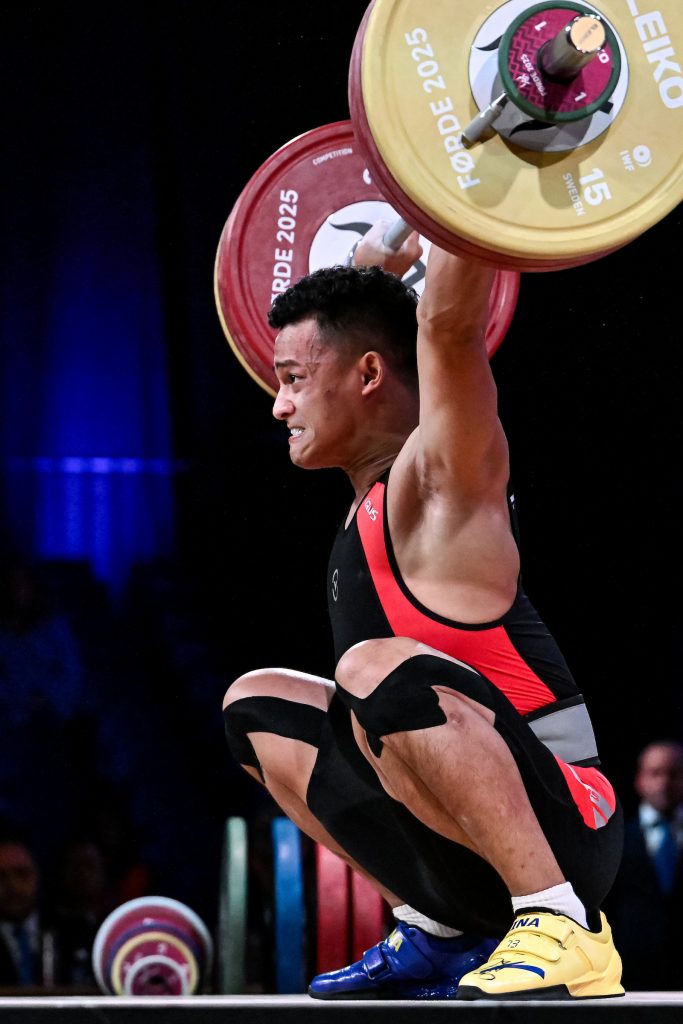
Rizki Juniansyah (INA)
His 157-204-361 left Rizki 1kg short of the record on total. He did not go for it. “I’ll leave that for next time, hopefully,” he said. Next time is the South East Asian (SEA) Games in Thailand in December.
After Rizki famously knocked Rahmat out of the Olympic Games in the final qualifier in April last year, he won gold in Paris. He outperformed Rahmat again at the SEA Games national trials in August and will lift at 79kg again in December, while Rahmat goes up to 88kg.
But that is only half the story. Rahmat injured his shoulder while making a snatch at those trials and did even know if he would lift at Fordehuset.
He decided to give it a go in the B Group, made four good lifts – one of them a clean and jerk world record of 203kg – and declined his final attempt in both snatch and clean and jerk.
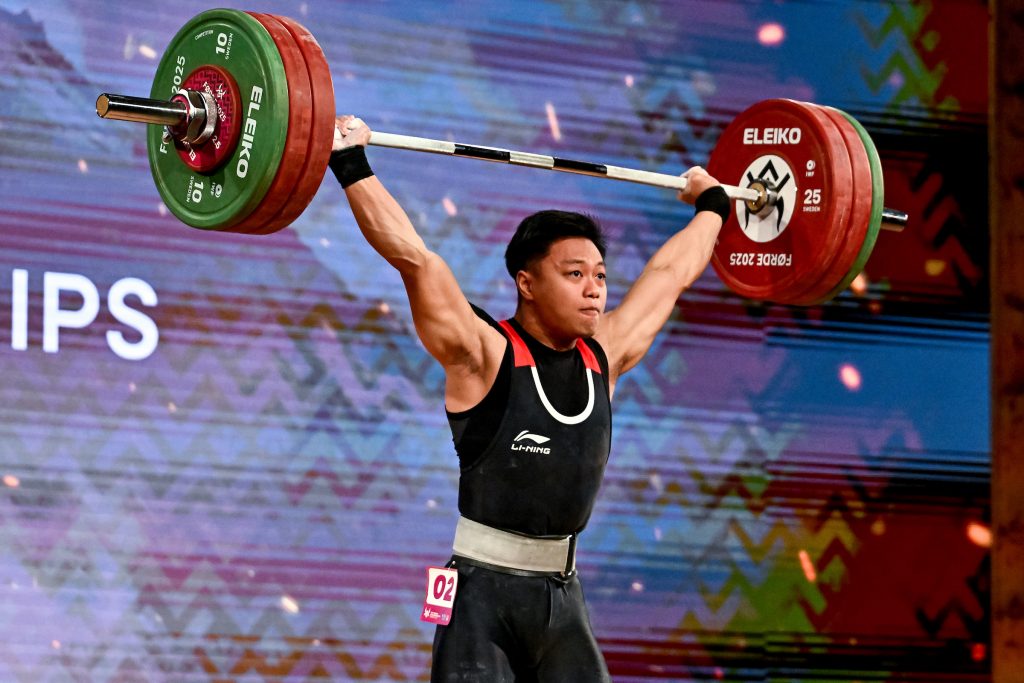 Rahmat Erwin (INA)
Rahmat was 3kg short of the world record on total on 156-203-359 from his four lifts but, remarkably, that was not enough for a medal on total even though nobody beat the record. Ri Chong Song from PRK and Abdelrahman ‘Abdo’ Younes from Egypt both totalled 360kg in second and third place. Ri made 163-197-360 and Younes 162-198-360.
“It could be a small tear but I don’t want surgery,” Rahmat said. “The doctors said I had to rest, so I could only train properly for a week for these Championships. I haven’t been fit enough for clean and jerks, and you can see my body fat percentage has gone up.”
Ri, who has made plenty of big totals before, had two white lights for his 201kg final attempt but lost it on jury review for bending and extending. Younes, 20, clearly thought he would win, and left the platform in tears after also failing on 201kg. He also lost a lift on review.
Yedige Yemberdi from Kazakhstan, who like Younes roused the crowd on a noisy night, missed a junior world record attempt on 199g, and teenager Ning Gan from China twice failed with junior record attempts. Son Hyeonho from Korea, who bombed out in snatch, missed at 205kg for a clean and jerk world record.
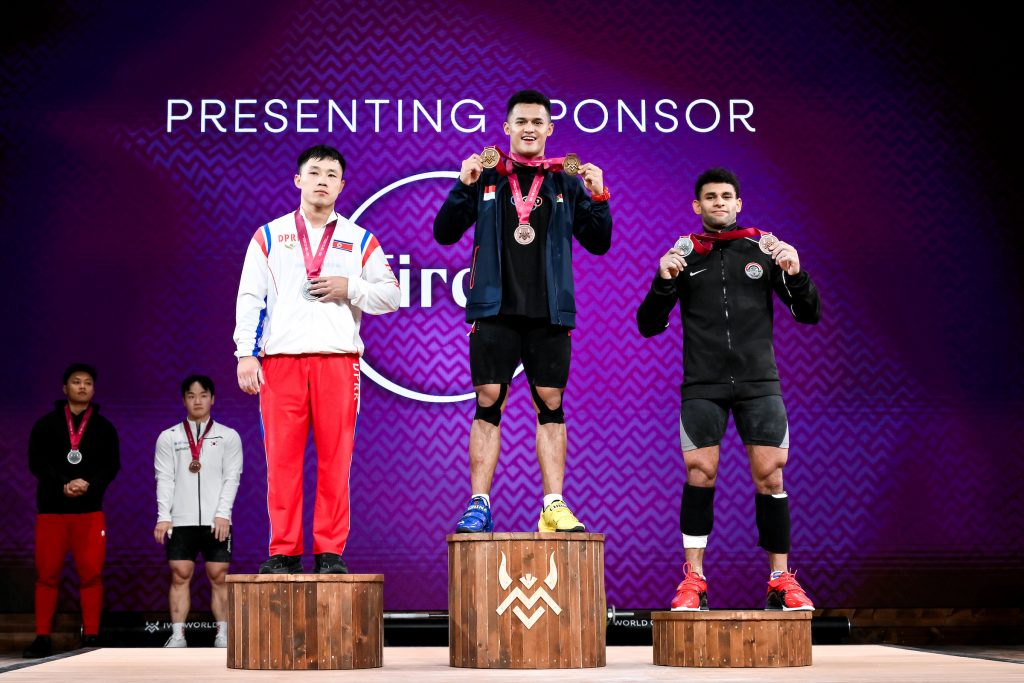 The men’s 79kg podium
Nine of the top 10 were born this century, six were aged 22 or younger, and we will be seeing plenty more of them.
The United States also had athletes in both A and B Groups. Ryan Grimsland, who has plenty of relatives in Norway – from where his grandfather moved to the US – put 15kg on his career-best total in the B session on 342kg.
Caden Cahoy, one of the biggest improvers in the USA team, went for 204kg after Rizki and finished fifth on a career-best 155-198-353.
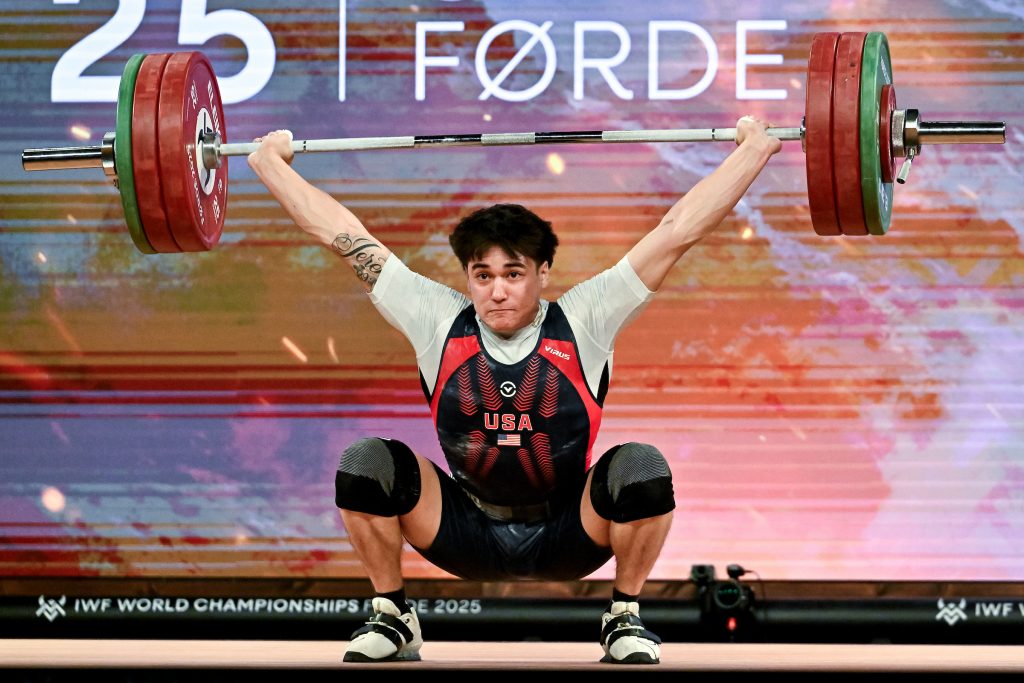 Caden Cahoy (USA)
The difference between the day’s biggest attempt and the smallest was 175kg, which could be a record. Chris Murray from Great Britain, who had shoulder surgery two months ago, went for 30kg openers in the D Group and dropped the bar as soon as it was above his knees. He declined his other four attempts, finishing without a total.
This scenario was caused by a new rule for those attempting to qualify for the Glasgow 2026 Commonwealth Games. In the past, athletes have had to “participate” in mandatory qualifying events for a big Games, which meant they did not have to lift if they were not fully fit or chose not to. They could weigh-in, be introduced to the audience, make themselves available for anti-doping testing, and withdraw without lifting.
Large numbers of withdrawals during the Olympic qualifying period caused problems for broadcasters and for the image of weightlifting. The Commonwealth Weightlifting Federation (CWF) and the IWF decided that athletes must now “compete” rather than “participate”. They have to attempt lifts.
“I was pretty embarrassed about it,” said Murray. “I didn’t want to lift, but they (CWF) haven’t announced another qualifying competition so I had to do it. It’s not a great situation if you’re not fit.”
Murray won at 81kg at the Birmingham 2022 Games and is hoping to be fit to win again after an horrific run of injuries and illnesses in the past 18 months. He had a serious elbow injury, tore a hamstring, had two quad tears, suffered glandular fever and shingles, and two months ago he had surgery on a badly damaged shoulder.
“So far this year I have had one week of uninterrupted training,” he said. “Every time there’s a new injury you hit another low point, but you go through it day by day, believing that it will all come right in the end. I’ve had to learn to cope with it, with the help of a very good support network at GB Weightlifting that wasn’t there a few years ago.”
His recovery period for the shoulder surgery is three to six months. Murray is aiming to make a good enough total at the European Championships next April to qualify for Glasgow.
By Brian Oliver
Photos by Giorgio Scala/Deepbluemedia